The efficiency of the light Emiting Diode (LED) driver is the rato of energy emited by the driver to the power it consumes from the electric line. thhigher the conversion efficiency
The efficiency of the light Emiting Diode (LED) driver is the rato of energy emited by the driver to the power it consumes from the electric line. the higher the conversion efficiency, the higher the utilization rate of electric energy,which means that the power consumption is not so much;the high the conversion efficiency, the lower the loss, and the less heat generated by the constant voltage led power supply.
Let’s express our definition in a simple formula;
LED Driver Efficiency=(output power/input power)* 100%
For example:
Load 100W lights = output power.
The input power is 120w.
Efficiency=(100w/120W)100%=83%
Then the conversion efficiency of this power supply=83% Why is the efficiency of output voltage 12V and 24V different when calculating the led driver effciency?This is the law of ohvsics, The higher the inout voltaee,the higher the conversion efhciency,The conversion efhciency is actually measured, so the dataon the KSPOWER specification is relatively standard.What ls input Power?Input power is the amount of energy that gets into a device or system.In this case, the device or system is the LED driver. The input power is the energythat comes into your electric bulb from the main supp, so what the LED driver wil give out is highly dependent on the input power with the unit inwatts.What ls Output Power?Output power is the amount of energy delivered by a device, circuit, or system.“what happens after the lED driver receives the energy (input powerfrom the electric line?, The best answer is that it supplies this power to the LED system.Key Factors Affecting EfficiencyWhen we talk about eficiency, it wil be an error not to consider its driving force, The eficiency of a LED driver hinges on the input voltage and load(output voltage).Let’ s take a look at the chart below:
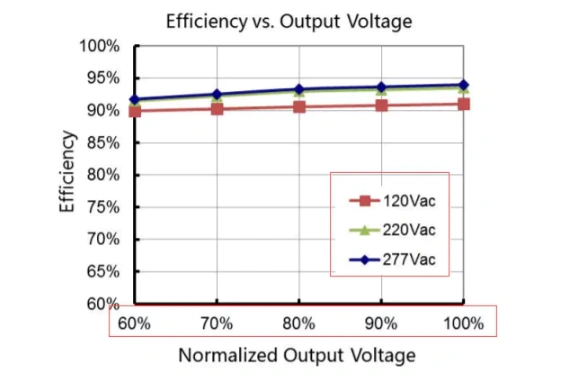 There are diferent power grids in the world. For example, we have 120 Vac and 277vac for the North America and 220 Vac for most of other areas.Looking at the chart, we can see that efficiency is diferent with both input voltage and output voltage which is also load in terms of a constant currentLED driver.Losses In Power supply EfficiencyEnergy losses occur in power supply; as a result,it’s impossible to have a 100% power supply. Active and passive componentlosses are the catalst forenergy loss in the power supply. The energy loss occurs in resistors, capacitors, inductors, diodeconjunction, and (MOSFET...Passive Component LossPassive components are those part of the device that does not need the extra control signal to operate, including diodes, transformers, capacitorsinductors,and resistors.Active Component LossIn contrast to the pasive components, active components need power for their operation. Therefore, they can produce power gain and amplify signals.The active components include a transistor, integrated circuit, SCR, MOSFET, etc.Other LossDue to the existence of parasitic resistance of the components like PcB, cable, there are power loss occuring on the path through which the currentgoes.Why Use High-Effciency Driver?
Energy and Cost SavingThe first reason why you should use a high-etficiency driver is to save cost. Remember when the lighting will pull out significant money from your pocketdue to high energy consumption, That’s why the whole industry turned towards LeD lighting.It’s an opportunity to take fu advantage of cost savings with high-eficiency drivers. They require lesser energy input to provide the needed luminousoutput.Increased Product LifespanThe higher the driver’ s efficiency, the lesser the heat it dissipates, and the longer the system’s lifeHigh Efficiency LED DriverWith up-to-date technology and practice, KSPOWER provides the following:100-240VAC Input Power AdaptorConstant Voltage LED DriverDimmable LED Transformer


